
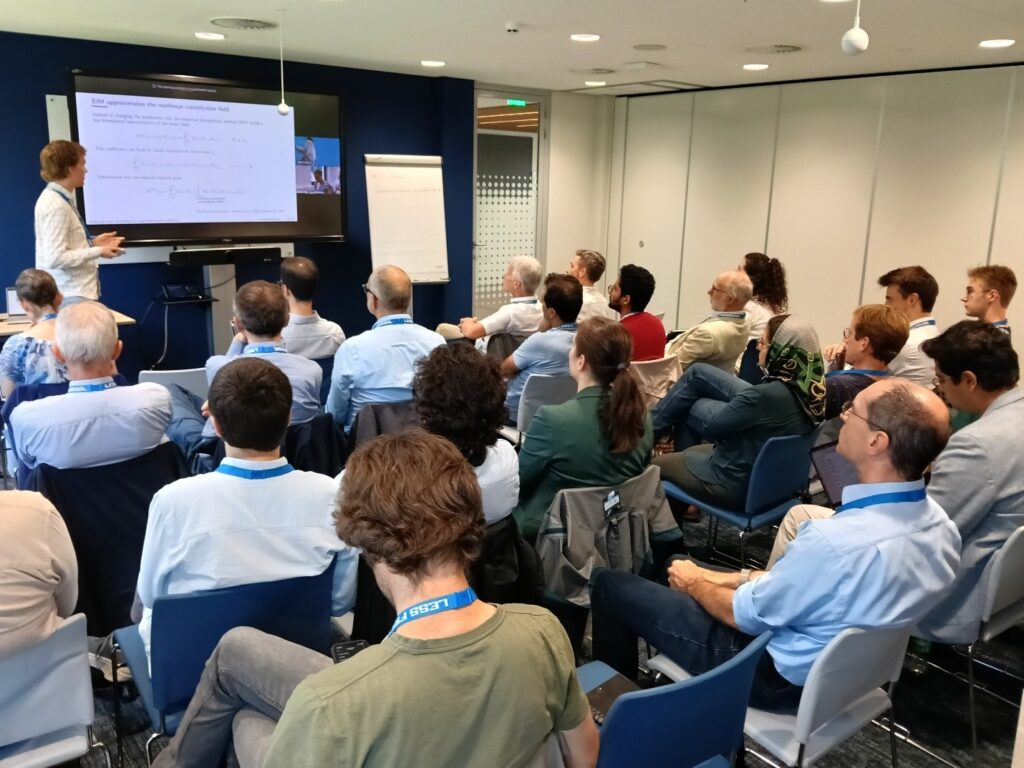
On 1 September 2026, the DEPMAT consortium met at SKF in Houten to review progress and, above all, to look at how the different research developments can now be brought together. The meeting included updates on the programme’s Impact Pathway, a dedicated discussion on the demonstrator, and presentations from researchers.
The discussions returned to the fundamental challenge for which DEPMAT was established: how can the steel industry use substantially more recycled material without losing control over product quality?
DEPMAT develops data-enhanced physical models that can predict the effects of variation in steel composition and support adjustments of production and manufacturing conditions. Here the progress made in different work packages is summarized.
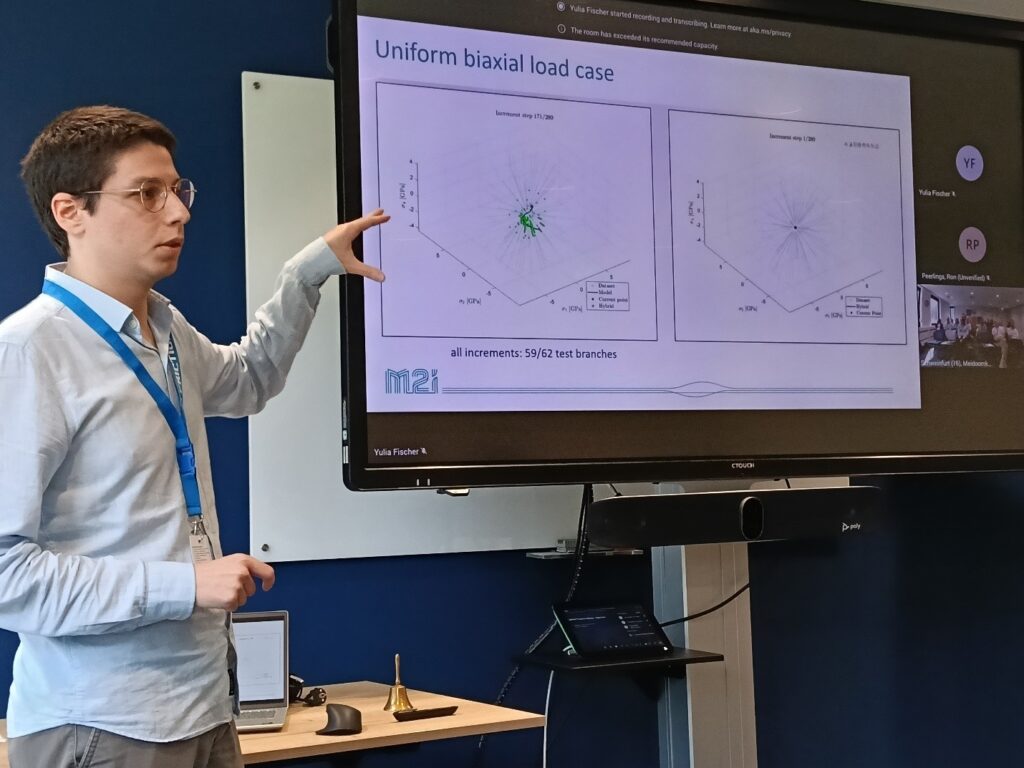
WP1 develops the material models needed to describe how steel behaves when its composition, microstructure and processing history change. Recent work has strengthened both hybrid data–physics approaches and thermodynamically consistent neural constitutive models. A new hybrid framework can describe anisotropic yielding and hardening using a limited number of material datapoints, while the Energy-Ceiling approach provides a physically constrained neural framework for metal plasticity.
At the same time, experiments on recycled near-IF steels have shown that changes in impurity composition can alter crystallographic texture and, consequently, the r-value, an important measure of sheet-metal drawability. The measured texture was successfully used in a numerical mean-field model to reproduce the observed changes in r-value. The research also suggests that different combinations of residual elements can lead to distinctly different forming behaviour.
This work is directly relevant to the overall DEPMAT goal. If the mechanical behaviour of steel with varying recycled content can be predicted accurately from limited measurements and microstructural information, it becomes possible to generate reliable material descriptions for forming simulations.
Using more recycled material does not only require better material models; manufacturers also need to know what is actually happening during production. WP2 therefore focuses on process models, indirect measurements and uncertainty.
Cold-rolling models are being developed to connect rolling parameters and measured forces to material behaviour. A Bayesian framework based on the MiReX recrystallisation model is being used to estimate microstructural evolution during annealing while explicitly accounting for uncertainty. Work on hot-strip processing addresses temperature-measurement errors and anomalies related to oxide formation, while electromagnetic measurements are being investigated as a way of obtaining information about microstructure without destructive testing.
The connection to higher recycled content is important: composition changes influence how material responds to rolling and heat treatment. If the actual material state can be inferred from process measurements, production settings no longer have to be based only on an assumed “standard” material.
WP3 addresses another major obstacle: many physics-based materials models are simply too computationally expensive to evaluate the large number of composition and processing combinations that arise when recycled content increases. At the atomic scale, machine-learning interatomic potentials are being developed to study how tramp elements interact with the iron matrix and grain boundaries. These models can help identify when segregation or other composition-related effects are likely to become important. At the microstructure scale, machine-learning diffusion models can predict microstructure evolution much faster than conventional simulation approaches while retaining important characteristics such as phase morphology and grain statistics.
WP4 takes a complementary, more directly data-driven route. The aim is to predict material properties from composition and process information across the production chain.
Recent work has benchmarked advanced tabular foundation models, including TabPFN and LimiX, using Tata Steel and Outokumpu datasets. The models have also been tested on real Tata Steel production data. Results show strong potential, while also highlighting an important practical challenge: models trained in one domain do not automatically transfer to another because industrial datasets and production routes differ. A DEPMAT ML Web App has also been developed to allow datasets to be uploaded, analyzed and evaluated with different models more easily.
The most important next step is to bring these research developments together in WP5. The current demonstrator plan follows the complete process chain—from hot rolling through cold rolling, annealing and temper rolling to the final forming operation. Two functions are central: predicting whether material with a changed composition will still perform correctly in a forming application and determining whether the production recipe can be adapted to compensate for composition-induced changes.
This demonstrator is where the individual scientific developments become directly connected to the original DEPMAT ambition. The scientific work packages have developed increasingly mature building blocks; the challenge now is to connect those building blocks and demonstrate their value in an industrially relevant chain.
That integration is essential because using more recycled steel is not simply a question of adding more scrap to the melt. The resulting variation must be understood, predicted and managed all the way from steel production to the final manufactured product.
By making that possible, DEPMAT aims to remove one of the technical barriers to higher recycled content in high-quality steels. In turn, greater use of recycled iron can reduce dependence on primary iron production and contribute to lowering the CO₂ impact of the steel value chain — while continuing to deliver the material performance that industrial users require.